




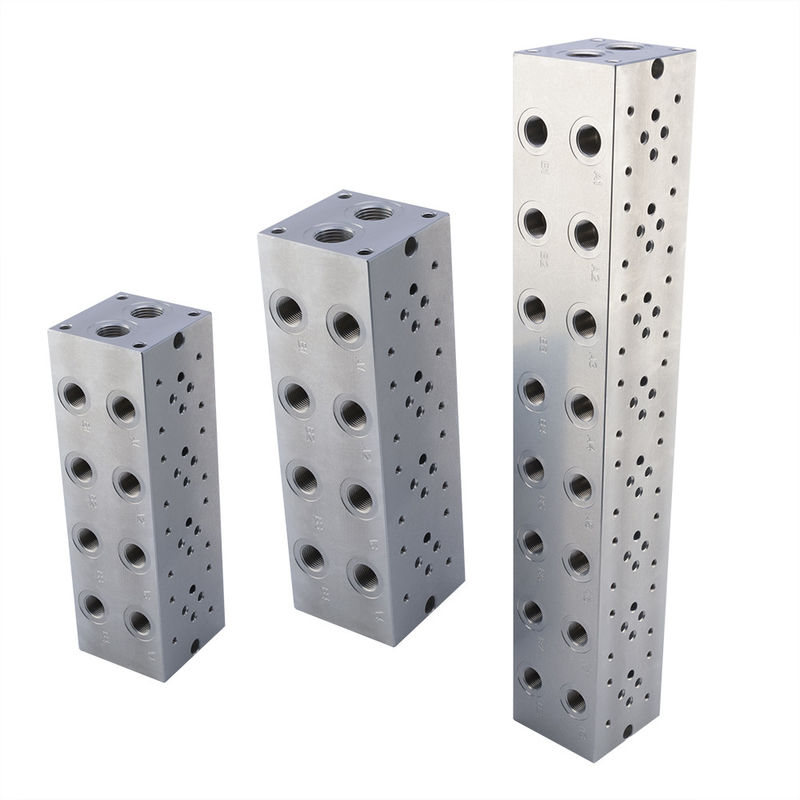
A key advantage of multi-functional hydraulic integrated valve blocks lies in their seamless integration with cartridge valves (threaded insert valves), which delivers exceptional universality. Cartridge valves follow standardized thread sizes, pressure ratings, and flow capacity specifications (e.g., ISO 7368 standards), allowing the valve block to accommodate different types of cartridge valves—such as relief valves, check valves, directional control valves, and flow control valves—without requiring structural modifications. This universality simplifies inventory management for manufacturers and maintenance teams: instead of stocking custom-designed valve assemblies, they can use interchangeable cartridge valves to replace faulty components or reconfigure functions. For example, in a construction machinery hydraulic system, swapping a standard 3/4-inch thread relief cartridge with a flow control cartridge enables the valve block to switch from pressure protection to flow regulation, reducing downtime and replacement costs.
Multi-functional hydraulic integrated valve blocks excel at centralized function integration, eliminating the need for complex external piping networks that connect individual valves. A single valve block can integrate multiple hydraulic functions, including pressure control, flow adjustment, directional switching, and load holding, into a compact unit. This integration not only reduces the overall size of the hydraulic system (by up to 40% compared to discrete valve setups) but also minimizes pressure losses caused by long piping runs—improving system efficiency and response speed. For instance, in agricultural equipment like harvesters, a single valve block can simultaneously control the hydraulic motors for crop cutting, the lift cylinders for the header, and the pressure relief for overload protection. Additionally, the modular design allows for easy customization: manufacturers can add or remove cartridge valves to tailor the valve block’s functions to specific application needs, such as adding a counterbalance valve for vertical load stability in lifting systems.
These valve blocks are highly versatile and suitable for diverse industrial scenarios where reliable hydraulic control is critical. In the construction sector, they are used in excavators, cranes, and concrete pumps to manage heavy load lifting and precise arm movement. In the manufacturing industry, they integrate into automated production lines to control hydraulic presses, robotic arms, and material handling equipment—ensuring consistent force and speed output. The automotive sector also benefits, as valve blocks regulate hydraulic systems in vehicle lifts, assembly line tools, and testing equipment. Their ability to operate under varying pressure (typically 10-35 MPa) and temperature (-20°C to 80°C) conditions further expands their applicability to harsh environments, such as mining machinery (resisting dust and vibration) and marine equipment (withstanding moisture and corrosion).
Multi-functional hydraulic integrated valve blocks are constructed from high-performance materials to ensure long-term durability and reliable operation. The most common material is carbon steel (e.g., SAE 1045) or alloy steel (e.g., 42CrMo), which undergo heat treatment (quenching and tempering) to achieve a hardness of 28-32 HRC—enhancing resistance to wear, impact, and deformation under high pressure. For applications requiring corrosion resistance (e.g., food processing, marine, or chemical industries), valve blocks are made of stainless steel (e.g., 304 or 316), which prevents rust and contamination. The internal flow channels of the valve block are precision-machined using CNC drilling and honing techniques, ensuring smooth surface finishes (Ra ≤ 0.8 μm) that reduce fluid turbulence and pressure drop. Additionally, the material’s high tensile strength (≥ 600 MPa for carbon steel) and fatigue resistance enable the valve block to withstand repeated pressure cycles, extending its service life to 5-10 years in typical industrial applications—lowering maintenance frequency and total ownership costs.