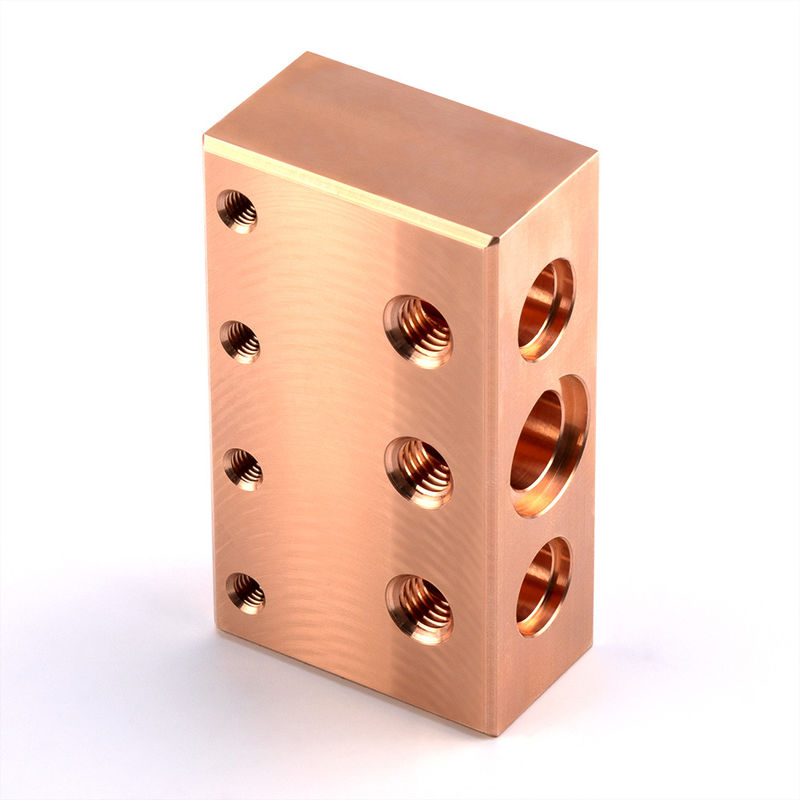
Core Characteristics of Brass Hydraulic Manifolds (Categorized by Pressure, Application Scenarios, Wear Resistance, Corrosion Resistance, and Material Machinability)
Brass hydraulic manifolds serve as the "control hub for oil flow" in hydraulic systems, and their performance relies heavily on material properties and structural design. The following is a detailed explanation from five key dimensions:
1. Pressure Adaptation Range: Focus on Medium and Low-Pressure Systems with Clear Application Scenarios
The mechanical strength of brass (tensile strength of approximately 300-500 MPa, yield strength of approximately 150-300 MPa) determines that its pressure adaptation upper limit is lower than that of steel/cast iron manifolds. The core adaptation range and characteristics are as follows:
- Normal Working Pressure: Most brass hydraulic manifolds are used in medium and low-pressure systems of 10-25 MPa, such as small hydraulic stations and control circuits of pneumatic-hydraulic composite equipment, and can stably withstand continuous oil pressure without deformation or cracking.
- Pressure Upper Limit Restriction: A few brass manifolds that have undergone reinforced processing (such as quenching and tempering, wall thickness optimization) can withstand a pressure of 30-35 MPa in the short term, but long-term use is prone to micro-deformation of internal oil passages due to material fatigue, thereby affecting oil flow control accuracy. Therefore, they are not recommended for high-pressure (>35 MPa) hydraulic systems (such as the main circuits of large construction machinery and high-pressure injection molding machines).
- Pressure Adaptation Logic: Brass has better plasticity than steel. Under medium and low pressures, it can compensate for machining errors (such as sealing gaps at oil passage interfaces) through slight deformation, improving sealing reliability. However, under high pressure, plastic deformation will be excessive, which will damage the sealing structure instead. This is the core reason for its "medium and low-pressure positioning".
2. Application Scenarios: Focus on Miniaturization, Low Pollution, and Corrosive Environments
Based on the material properties of brass, its application scenarios are highly concentrated in medium and low-pressure hydraulic systems that require "lightweight, corrosion resistance, and low pollution". Typical scenarios include:
- Control Circuits of Small Hydraulic Equipment Such as small hydraulic cylinders (such as medical bed lifting, small fixture clamping) and valve groups supporting micro hydraulic pumps. The lightweight nature of brass manifolds (density of approximately 8.5 g/cm³, 15% lighter than steel) can reduce the overall weight of the equipment, and the machining accuracy of internal oil passages is easy to control, suitable for fine control of small oil flow (<20 L/min).
- Environments with Slight Corrosion Such as auxiliary hydraulic systems of marine equipment (such as small lifting devices on ship decks) and hydraulic stations of food processing machinery (such as hydraulic drives of sauce mixing equipment). The corrosion resistance of brass can resist slight corrosion from seawater mist and food raw material residues, avoiding blockage of oil passages due to rust of manifolds.
- Low-Pressure Pneumatic-Hydraulic Composite Systems Such as pneumatic booster hydraulic circuits (used for small workpiece stamping). Brass manifolds can be adapted to both compressed air (low pressure) and hydraulic oil (medium pressure) at the same time, and are not prone to rust due to gas-liquid mixing.
- Precision Hydraulic Control Scenarios Such as auxiliary manifolds of hydraulic servo valves (used for micro-feed control of machine tools). The low cutting resistance of brass enables it to process high-precision oil passages (aperture tolerance ±0.01 mm), ensuring the stability of oil flow.
3. Wear Resistance: Rely on Surface Treatment, Suitable for Medium and Low Wear Scenarios
Pure brass has low hardness (Brinell hardness HB60-80) and is less wear-resistant than steel (HB200+) or cast iron (HB150+). Surface treatment is required to improve wear resistance. The actual performance is as follows:
- Untreated State: In clean hydraulic systems with low oil flow velocity (<1 m/s) and no solid impurities, short-term wear resistance can be maintained (service life is about 1-2 years); if the oil flow contains impurities (such as metal debris), it is easy to cause wear on the inner wall of the oil passage, resulting in internal leakage.
- After Surface Treatment: Through "hard chrome plating" (surface hardness HV800+), "nitriding treatment" (surface hardness HV500+), or "PVD coating" (such as TiN coating, hardness HV2000+), wear resistance can be improved by 3-5 times, and it can be adapted to scenarios with oil flow velocity ≤3 m/s and moderate wear (such as control circuits of small hydraulic motors).
- Wear Resistance Limitations: Even after surface treatment, brass manifolds are still not suitable for high-wear scenarios, such as high-pressure and large-flow systems (strong oil flow scouring force) and scenarios where hydraulic oil contains a large number of solid particles (such as hydraulic systems of mining machinery). Otherwise, the surface coating is easy to fall off, leading to rapid failure of the manifold.
4. Corrosion Resistance: Significant Natural Advantages, Suitable for Multiple Corrosive Environments
The corrosion resistance of brass (copper-zinc alloy, zinc content 30%-40%) comes from the easy formation of a "passivation film" (cuprous oxide or basic copper carbonate) on its surface, which can isolate medium erosion. The specific performance is as follows:
- Corrosion Resistance to Water-Based Hydraulic Oil: In commonly used water-glycol hydraulic oil and emulsion, brass manifolds have no corrosion phenomenon, suitable for hydraulic systems that require fire prevention (such as auxiliary equipment of power plants).
- Corrosion Resistance to Mild Chemical Media: It can withstand weak acids (such as industrial wastewater with pH 5-8), weak alkalis (such as sodium hydroxide solution with concentration <5%), and organic solvents (such as antioxidants and rust inhibitors in hydraulic oil), and is not prone to chemical corrosion.
- Corrosion Resistance to Marine Environment: In marine atmosphere containing salt spray, the corrosion rate of brass is about 0.01-0.03 mm/year (much lower than that of steel, which is 0.1-0.3 mm/year), suitable for offshore or small hydraulic equipment on ships.
- Corrosion Resistance Shortcomings: It is not resistant to strong oxidizing media (such as concentrated nitric acid, chromic acid) and media containing ammonia/cyanide, and "dezincification corrosion" will occur (zinc is preferentially corroded, resulting in a porous and loose structure on the surface of the manifold). Therefore, such application scenarios should be avoided.
5. Material Machinability: Excellent Machining Performance, Suitable for Complex Structures
Brass is a representative of "machining-friendly" in metal materials. Its machinability is low, and it is suitable for mass production of manifolds with complex structures. The core advantages are as follows:
- Machinability in Cutting: Brass has low cutting resistance (about 60% of steel), and is easy to process by milling, drilling, boring, tapping and other processes. Moreover, the machining surface roughness is easy to control (up to Ra0.8-1.6 μm), suitable for machining surface mounting holes (such as threaded holes, positioning holes) of manifolds and internal complex oil passages (such as cross oil passages, blind holes). The machining efficiency is 30%-50% higher than that of steel manifolds.
- Casting Machinability: Brass has a low melting point (about 900-950 °C, lower than 1538 °C of steel) and good fluidity. It can be made into near-net-shape manifold blanks by sand casting and die-casting processes (reducing subsequent machining volume), especially suitable for mass production of small and medium-sized manifolds (weight <5 kg).
- Forming Machinability: Brass has good plasticity and can be made into special-shaped structures (such as arc manifolds, integrated manifolds) by forging and extrusion processes to enhance material density (reduce internal pores), so as to meet the needs of special installation spaces.
- Machining Cost: Due to high machining efficiency and low tool wear (brass has only 1/3 of the tool wear of steel), the machining cost of brass manifolds is 20%-40% lower than that of steel manifolds of the same specification, suitable for cost control of small and medium-sized hydraulic equipment.
In summary, the core advantages of brass hydraulic manifolds are "good corrosion resistance, easy machining, and lightweight", and the core limitations are "low pressure resistance and weak wear resistance". Therefore, their application scenarios are highly focused on small hydraulic systems with medium and low pressure, low wear, and mild corrosion requirements, and they are high-quality alternatives to steel/cast iron manifolds in such scenarios.


 Your message must be between 20-3,000 characters!