Highlight:
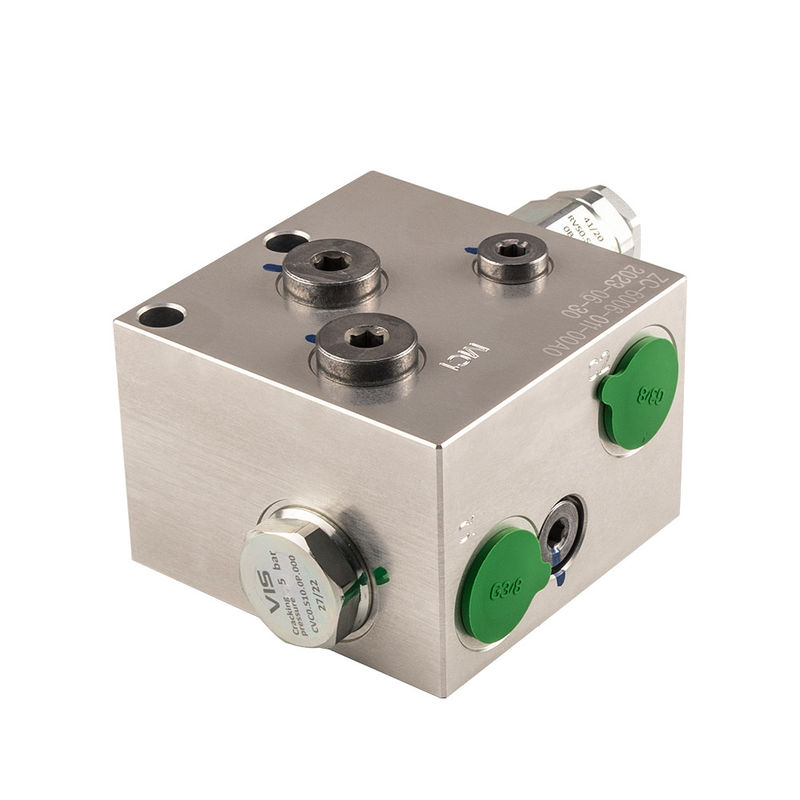
Precision Hydraulic Manifold
, Hydraulic Manifold Aluminum Alloy
, Precision Hydraulic Valve Block
Product Name: |
Hydraulic Valve Block, Etc. |
Material: |
Aluminum Hydraulic |
Keyword: |
Hydraulic Vavle |
Work Pressure: |
Max 350bar |
Quality Assurance: |
100% Hydraulic Function Testing |
Surface Treatment: |
Anodizing, Sandblasting, Electrolytic Polishing, Knurling, Laser/etching/engraving, Etc. |
Service: |
CNC Turning And Milling, Laser Cutting, Wire Cutting, Stamping, Injection Molding |
Temperature: |
-30~120℃ |
Different materials for hydraulic manifolds have their own advantages and disadvantages. Here is a comparison of some common materials:
Stainless steel
Pros:
Corrosion resistance: Stainless steel has good corrosion resistance to a variety of environments, especially in salty or chemically corrosive environments.
Heat resistance: Able to work at higher temperatures without softening.
High strength: Has high mechanical strength and is suitable for high-pressure systems.
Easy to clean: The smooth surface makes it easy to clean and helps keep the system hygienic.
Disadvantages:
Cost: Compared with other materials, stainless steel is more expensive.
Weight: It has a higher density and is heavier, which may not be ideal for weight-sensitive applications.
Aluminum alloy
Pros:
Light weight: It has a low density and is light, which is suitable for weight-sensitive fields such as aerospace and automotive.
Lower cost: Compared with stainless steel, aluminum alloy is less expensive.
Good thermal conductivity: Helps dissipate heat and keep the system temperature stable.
Easy to process: Has good machinability and formability.
Disadvantages:
Corrosion resistance: Not as good as stainless steel, especially in salty environments.
Strength: Although the strength can meet most applications, it is not as high as stainless steel and may not be suitable for extremely high-pressure systems.
Carbon Steel
Advantages:
Cost: Carbon steel has a relatively low cost.
Strength: Has high mechanical strength and is suitable for high pressure systems.
Disadvantages:
Corrosion resistance: Carbon steel rusts easily and requires additional coatings or treatments to improve corrosion resistance.
Weight: Heavier than aluminum alloys and not as suitable for weight-sensitive applications.
Brass and Bronze
Advantages:
Corrosion resistance: Brass and bronze have good corrosion resistance.
Easy to machine: These copper alloys are easy to machine.
Disadvantages:
Strength: Not usually suitable for high pressure systems due to their low strength.
Cost: Some types of brass and bronze are expensive.



 Your message must be between 20-3,000 characters!
 english
 français
 Deutsch
 Italiano
 Русский
 Español
 português
 Nederlandse
 ελληνικά
 日本語
日本語
 한국
한국
 العربية
 हिन्दी
 Türkçe
 indonesia
 tiếng Việt
 ไทย
ไทย
 বাংলা
বাংলা
 فارسی
فارسی
 polski