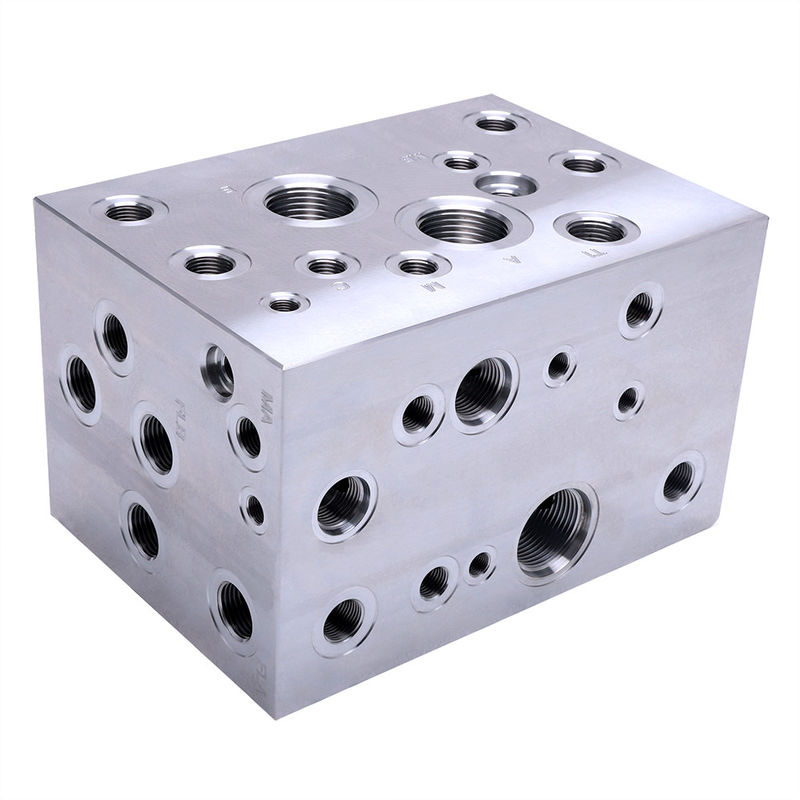
Application of CNC Custom Hydraulic Manifolds on Excavators
Hydraulic valve blocks serve as the central control hub in excavator hydraulic systems, managing oil distribution, pressure and flow regulation, and coordinating operational logic. By integrating multiple valve groups, they streamline pipeline connections, minimize leakage risks, and enable precise control over excavator functions including digging, rotation, and movement.
Hydraulic Valve Block Types and Functions
Main Valve Block - Primary Machine Operation Controller
The main valve block forms the core of the excavator's hydraulic system, directly controlling direction, pressure, and flow in the main oil circuit to operate the bucket, boom, arm, rotation platform, and travel mechanisms.
- Integrated Components: Main directional control valves, main relief valves, overload replenishing valves, and flow control valves
- Boom Operation: Controls lifting, lowering, and positioning while regulating speed for stable performance under heavy loads
- Arm and Bucket Control: Coordinates arm extension/retraction and bucket digging/dumping with pressure compensation for consistent power
- Rotation Management: Adjusts platform rotation direction and speed while incorporating buffer valves to minimize hydraulic shock
- Travel Operation: Independently controls left/right track movement with high-low speed switching capability
- System Protection: Main relief valves set maximum system pressure (30-35MPa) while overload valves prevent cavitation
Pilot Valve Block - Control Signal Source
Using low-pressure oil (2-5MPa), the pilot valve block converts operator control inputs into hydraulic signals that drive the main directional control valves.
- Integrated Components: Pilot directional control valves, pilot relief valves, and check valves
- Operation Translation: Converts mechanical handle displacement into proportional hydraulic control signals
- Precision Control: Enables stepless speed regulation through proportional main valve spool displacement
- Circuit Protection: Pilot relief valves safeguard against excessive operating force damage
Auxiliary Valve Blocks - Specialized Function Support
These valve blocks provide dedicated control for specific auxiliary functions and operate in conjunction with the main valve block.
- Rotation Buffer Valve: Reduces hydraulic shock during platform start/stop cycles
- Travel Speed Limiting Valve: Prevents rapid movement during operation while allowing efficient transit
- Boom Holding Valve: Maintains boom position to prevent settling and ensure lifting safety
- Breaker/Grapple Valve: Controls auxiliary tool functions including breaker frequency and grapple operation
Hydraulic Valve Block Materials and Selection Criteria
Excavator hydraulic valve blocks must withstand high pressure (30-40MPa), frequent vibration, and oil corrosion while maintaining precise internal passage tolerances (≤0.02mm). Material selection prioritizes strength, pressure resistance, machinability, and corrosion resistance.
45# High-Quality Carbon Structural Steel (Primary Material)
With tensile strength ≥600MPa and yield strength ≥355MPa, this material offers excellent machinability and cost-effectiveness. Heat treatment achieves HB220-250 hardness while honing ensures oil passage roughness ≤0.8μm. Used in over 90% of excavator main and pilot valve blocks.
27SiMn Alloy Structural Steel (High-Pressure Applications)
Providing tensile strength ≥835MPa and superior impact toughness, this alloy suits heavy-duty applications. Heat treatment and localized surface hardening (HRC50-55) enhance wear resistance. Ideal for large excavators (20+ tons) and breaker-specific valve blocks.
Aluminum Alloy (Lightweight Solutions)
6061-T6 aluminum offers 1/3 the weight of steel with excellent corrosion resistance after anodizing. While tensile strength is lower (≥310MPa), it serves well in pilot and auxiliary valve blocks for smaller excavators (under 6 tons) operating at ≤20MPa.
Stainless Steel (Corrosion-Resistant Applications)
304 or 316 stainless steel provides exceptional corrosion resistance in harsh environments. Despite lower hardness and higher processing complexity, it's essential for valve blocks in mining, coastal, and corrosive applications.
Manufacturing Specifications

| Process |
CNC milling, drilling, tapping, grinding, polishing, deburring |
| Tolerance |
±0.002-±0.005 or per customer specifications with 100% QC inspection |
| Surface Treatment |
Sandblasting, anodizing, powder coating, plating, polishing, electrophoresis, galvanizing, PVD coating |
| Testing Equipment |
CMM, height gauge, micrometer, plug gauge, hardness tester, roughness measurement |
| Specification |
OEM service strictly following drawings and samples |
| Application |
OEM CNC machining, mining accessories, machinery components, truck parts, auto parts, industrial components |
| Drawing Format |
2D (PDF/CAD) 3D (IGES/STEP) |
Quality Assurance and Manufacturing Capabilities
- Highly skilled workforce operating under structured management systems
- Rapid response and support for all customer inquiries
- Over 10 years of professional manufacturing experience ensuring product quality
- Substantial production capacity to meet volume requirements
- Stringent quality standards maintained in hygienic production environments
- Comprehensive quality control process:
- Incoming Quality Control (IQC) - Raw material verification
- In-Process Quality Control (IPQC) - Manufacturing stage inspections
- Final Quality Control (FQC) - Finished goods validation
- Outgoing Quality Control (OQC) - 100% pre-shipment inspection
- Dedicated after-sales service and support
Summary
Hydraulic valve block design and material selection combine functional requirements with operational conditions. Main valve blocks prioritize strength and pressure resistance using 45# or 27SiMn steel, pilot valve blocks balance precision and cost with 45# steel, while auxiliary valve blocks employ steel or aluminum based on tool connectivity and weight considerations. Processing techniques including heat treatment and honing critically impact performance, where insufficient oil passage precision or surface quality can lead to operational issues and leakage.


 Your message must be between 20-3,000 characters!
 english
 français
 Deutsch
 Italiano
 Русский
 Español
 português
 Nederlandse
 ελληνικά
 日本語
日本語
 한국
한국
 العربية
 हिन्दी
 Türkçe
 indonesia
 tiếng Việt
 ไทย
ไทย
 বাংলা
বাংলা
 فارسی
فارسی
 polski